
Market Matters – Four years and counting…
Summary:
- The bull market’s age is not a reason to write it off. Company profits are still expected to grow strongly, while recent falls have made shares cheaper relative to those expected profits. That provides support for markets, although businesses still need to deliver and not every share represents good value.
- AI’s progress continues despite falling technology shares. Demand for chips and computing capacity remains strong, and businesses are finding more uses for AI. However, expensive borrowing and limits on electricity supply can undermine individual projects. Financial strength matters, even where the longer-term opportunity remains attractive.
- Inflation continues to complicate the outlook for interest rates. Higher energy prices and continuing pressure on other costs make US rate cuts harder to justify. Higher borrowing costs are already helping to restrain activity, leaving the Federal Reserve balancing inflation control against the risk of slowing the economy too sharply.
- There are encouraging developments beyond the US, alongside familiar challenges. UK growth has been more resilient than the prevailing mood suggests, while Germany shows signs of recovery. Inflation and government finances remain constraints. In Japan, corporate reforms and improving shareholder returns continue to support the investment case despite rising interest rates.
- China’s export success has not resolved its domestic problems. Strong overseas sales sit alongside cautious households, subdued spending and continuing property-market weakness. Investment in advanced manufacturing may strengthen China’s competitive position, but a broader recovery needs greater domestic confidence and spending, while trade tensions remain a risk.
Full market insight:
Four years and counting…
Four years ago, with inflation surging, interest rates rising and investors facing the prospect of recession, the outlook for equities was decidedly uncomfortable. Few would have expected the bull market that began in October 2022 to survive quite so many shocks, let alone deliver such substantial gains. Yet here we are, four years on, contemplating another bout of turbulence with the MSCI World index having more than doubled on the price-return measure shown below. It is a useful moment to consider whether this advance is becoming old and vulnerable, or whether there is still enough underlying support for it to continue.
History suggests that age alone is a poor guide. As the accompanying chart shows, J.P. Morgan’s comparison puts the current MSCI World advance at 48 months and a price gain of 107% to 30 September. Several earlier advances ran for five, six or even close to eight years, while some generated much larger returns. None of this guarantees that today’s market will follow the same path, but it does challenge the notion that four years must represent the closing stages of an equity expansion. Nor has the recovery been confined to American technology. Japan has been a particularly strong performer, Asian and emerging markets have participated impressively, and UK and European shares have made meaningful progress of their own. The bull market has been more international than the daily headlines might suggest.
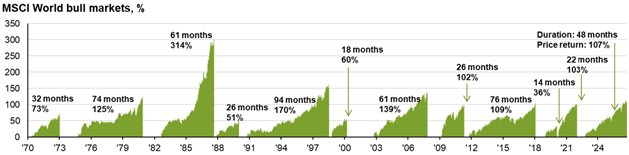
MSCI World bull markets, 1970–30 September 2026. Price returns excluding dividends. Source: LSEG Datastream, MSCI and J.P. Morgan Asset Management. Currency basis is not specified in the source; these figures should not be read as verified GBP returns.
Earnings Still Have the Upper Hand
What is particularly encouraging is that company profits have done much of the heavy lifting. The US reporting season has begun with expectations for third-quarter S&P 500 earnings growth of around 29%. Only 9% of companies have reported, so it would be premature to declare victory. The opening bank results have offered some reassurance, although the season has been mixed relative to expectations and aggregate growth forecasts have edged lower. At around 29%, they nevertheless remain robust. The technology leaders are making an outsized contribution, yet the improvement is not restricted to them. Indeed, during the recent market weakness, some shares outside the biggest technology names have held up rather better. Over the week, the Dow rose 0.7% while the Nasdaq fell 4.5%, although the Russell 2000’s 3.0% decline shows that the resilience was far from universal.
US-dollar price-index changes, 9–16 October 2026; dividends excluded. Source: AP.
This makes the valuation chart especially interesting. Equity prices have retreated against a backdrop of still-strong forward earnings expectations, bringing price-to-earnings multiples down sharply. The S&P 500 is now trading at roughly 19 times expected earnings on the measure shown, approaching valuation levels seen around last year’s Liberation Day sell-off. The Magnificent Seven have also experienced a substantial derating, while mid- and small-cap companies trade on considerably lower multiples. That does not make every share cheap, and the market is still relying on ambitious profit forecasts being delivered. But it is an important distinction: this has so far been more a correction in what investors will pay for earnings than a collapse in the earnings themselves.
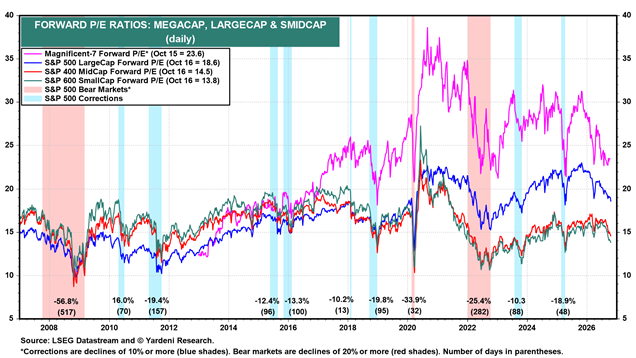
Forward P/E ratios: Magnificent Seven, S&P 500, S&P 400 MidCap and S&P 600 SmallCap, 2008–October 2026. Latest observations: 15 October for the Magnificent Seven; 16 October for the other indices. Multiples of expected next-twelve-month earnings. Source: LSEG Datastream and Yardeni Research.
AI: Look Beyond the Share Prices
After months of breathless headlines, investors have become understandably tired of hearing about the next astonishing model, the next giant data centre and the next extraordinary capital spending commitment. This week’s sharp decline in AI-related shares has encouraged renewed comparisons with the technology bubble of the late 1990s. Some of the financing arrangements certainly deserve close examination. Yet concentrating exclusively on share prices risks missing the much more important point: the AI revolution is not a prospectus for something that might happen one day. It is already happening.
The evidence from the semiconductor industry is increasingly persuasive. TSMC has just delivered another record quarter and continues to describe exceptionally strong demand for its most advanced manufacturing capacity. ASML’s latest results tell a similar story, with chipmakers planning equipment orders years ahead and the company expanding capacity to meet demand. The remarkable strength of the memory-chip industry, including Samsung and SK Hynix, reflects the growing need for high-bandwidth memory and other components essential to AI systems. Nvidia’s next results will provide another useful check, but the broader message is becoming difficult to ignore: computing requirements are increasing, the infrastructure is being built and customers are paying for the equipment.
Even these figures are only the first part of the story. Models are becoming more capable, the cost of obtaining a given level of capability has fallen substantially, and applications are spreading from simple information requests into software development, business processes and increasingly autonomous agents. Lower costs can themselves unlock further demand, just as cheaper computing and communications did during previous technological shifts. The commercial winners may change, and individual infrastructure projects may disappoint, but the direction of adoption appears much less uncertain than the direction of technology share prices.
There are risks, of course. CoreWeave’s October 2031 dollar bond briefly yielded more than 16% on Thursday, illustrating how much less forgiving credit markets have become towards heavily indebted AI infrastructure providers. We regard that as potentially healthy discipline, provided the stress remains contained, rather than evidence that underlying demand has disappeared. The strongest businesses can continue investing from substantial cash flows; weaker projects should face tougher questions about power availability, customer contracts, financing costs and prospective returns. The danger would be a loss of funding confidence that spreads far beyond the weaker borrowers, rather than isolated failures within an ambitious investment cycle.
Sunday brought a practical illustration: Reuters, citing the Telegraph, reported that Microsoft had withdrawn from Nscale’s Loughton data-centre agreement. Nscale pointed to grid constraints and said its other Microsoft contracts were unaffected. The episode highlights the importance of deliverable power alongside available finance.
Ultimately, the greatest economic benefits of AI may arrive well beyond the technology sector. If businesses can produce more output with the same people and resources, productivity improves and an economy’s sustainable growth rate can rise. That is potentially a powerful disinflationary force over time. The construction phase can be inflationary, not least because of the demands placed on electricity networks, materials and skilled labour, and it will take time before productivity gains become visible in national statistics. Nevertheless, the possibility of stronger growth without proportionately higher inflation is a compelling reason not to mistake today’s financing anxieties for the end of the AI story.
Inflation Refuses to Cooperate
Unfortunately, inflation is not yet behaving as policymakers would wish. September’s US consumer prices rose 3.7% over the year, with energy costs providing an important part of the acceleration. Gasoline alone accounted for more than half the monthly rise in the headline index. But the difficulty cannot simply be attributed to the disruption in energy markets. Core consumer prices rose 0.3% in September and 2.6% over the year, while services excluding energy were 3.1% more expensive than a year earlier. Those figures suggest that the underlying inflation problem has not disappeared. Rising education costs and pressure on household purchasing power add a political dimension to an already difficult economic problem.
Thursday’s producer-price figures offered little comfort either: final-demand prices rose 1.3% in September, while the measure excluding food, energy and trade services increased 0.5%. Those increases will not pass automatically into consumer prices, but they underline the pressure facing businesses.
There is some relief on the supply side. The IEA has agreed to accelerate the remaining releases under its existing emergency programme, including more than 20 million barrels of diesel. That may ease immediate shortages, but it does not restore normal transport routes or guarantee a lasting fall in fuel costs.
The bond market’s reaction was almost as revealing as the data. On Wednesday, the US ten-year Treasury yield briefly rose above 5.3% before retreating towards 5.18% as buyers returned, consistent with some demand for safety during the technology sell-off. By Friday, the Treasury’s daily ten-year par yield stood at 5.09%. The Federal Reserve is left in an awkward position. Inflation provides little justification for cutting rates, yet a sharp rise in longer-term borrowing costs and a more cautious credit market are already doing some of the work that higher policy rates would otherwise achieve. Another increase at the October meeting is therefore far from inevitable, even though the case for monetary easing has weakened considerably.
This interplay between markets and policymakers may prove important. Rising bond yields can curb speculative investment and slow demand without necessarily producing an economy-wide credit crunch. Equally, if they move too far, they threaten housing, investment and consumer spending. The task for the Fed is to preserve its inflation credibility without tightening so abruptly that it damages an economy which, for now, continues to show considerable resilience.
UK and Europe
There was some welcome news closer to home. The UK economy grew by 0.7% in the three months to August compared with the previous three months, following upwardly revised growth of 0.5% in the periods ending June and July. Services drove that three-month improvement, although August itself grew by just 0.1%, supported by production rather than services. That is encouraging ahead of the Budget, even if stronger activity does not remove the difficult decisions surrounding public spending, taxation and the government’s cost of borrowing. The Bank of England also has to weigh that better growth against inflation that remains uncomfortably high.
Across the Channel, Germany has raised its growth expectations, supported by infrastructure investment, defence spending and improved export prospects. It is a welcome sign that Europe’s largest economy may be emerging from its long period of stagnation. The recovery remains uneven, however: the economy ministry warned this week that momentum probably slowed in the third quarter, with high energy prices and financing costs continuing to restrain domestic demand.
However, euro-area inflation rose to 3.8% in September, with higher energy costs adding to persistent service-sector pressures. The improvement in growth is therefore arriving alongside a more difficult interest-rate environment. Concerns about fiscal sustainability, especially where borrowing costs are already elevated, provide another reason for European policymakers to remain cautious.
Japan and China
Japan remains one of the more interesting markets of this bull run. Corporate reforms, improving shareholder returns and a more durable inflationary environment have helped to transform investor perceptions. Yet that transformation comes with new challenges. The Bank of Japan has resumed the process of raising interest rates, while expensive imported energy and a weak currency squeeze household purchasing power. Japan is no longer the economy of persistent deflation that investors became accustomed to, and its equity market has shown that higher rates do not automatically preclude strong performance.
China presents almost the reverse problem. Its export machine is operating at extraordinary speed: the US-dollar value of exports rose 36.3% from a year earlier in September, driven in part by advanced manufacturing and technology-related products. Yet households remain cautious, domestic demand is subdued and the property market continues to weigh on confidence. The recent weakness in mainland Chinese shares, illustrated by the CSI 300 chart, contrasts with that export strength. Strong overseas sales have not been enough to dispel investors’ concerns about the domestic economy.
Beijing appears increasingly focused on securing industrial leadership in semiconductors, robotics, electric vehicles and other strategic sectors rather than delivering a large, immediate boost to consumption. That strategy can strengthen China’s competitive position and keep export growth strong, but it also risks intensifying trade friction with Europe and the United States. A more balanced expansion will eventually require households and domestic businesses to become more willing to spend and invest. For now, industrial strength and consumer weakness continue to coexist.
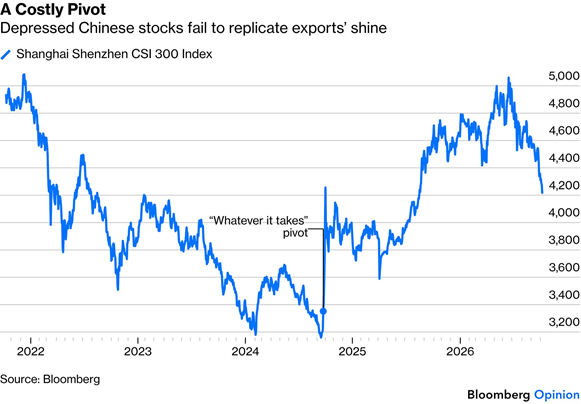
CSI 300 price index, 2022–October 2026: mainland Chinese equities have retreated despite strong export growth. Local-market index points; dividends excluded. Export data are discussed in the text and are not plotted. Source: Bloomberg Opinion, Bloomberg data.
This week…
The coming week will provide plenty of evidence to test both the encouraging and the uncomfortable parts of this outlook. Another wave of US earnings announcements should tell us whether corporate profitability is keeping pace with expectations, while China’s third-quarter growth figures on Monday, UK inflation on Wednesday and Friday’s flash business surveys will shed light on the international picture. Investors will also watch AI credit spreads and financing announcements closely to see whether recent stress remains concentrated among the most exposed borrowers.
Four years into the bull market, conditions are certainly demanding. Inflation is sticky, borrowing costs are high and the market has become less willing to pay any price for future growth. But corporate earnings are still advancing, the benefits of technological innovation are moving steadily closer to the wider economy, and investors are beginning to distinguish better between solid businesses and speculative commitments. That looks less like a bull market running out of time than one entering a more selective, and potentially health of problems to survive, but they do need earnings to keep justifying the faith placed in them. The next few weeks should tell us rather a lot about whether that faith remains well founded.