
Market Matters – When Good News Isn’t Enough
Summary:
- Strong AI fundamentals failed to restore confidence. Nvidia more than doubled quarterly revenue to $115.8bn and guided to around $130bn for the next quarter, which includes an extra week. Anthropic opened at $111.50 against an $83 offer price and ended Friday at $88.91. The fading gains underscored investors’ sensitivity to valuations, governance, export controls and the financing of the AI buildout.
- The correction broadened across global equities. The S&P 500 fell 8.6% in US dollar price terms over five sessions and ended 11.6% below its October closing record. The Nasdaq-100 finished nearly 20% below its October peak. Equal-weight US indices held up better, and government bonds provided some ballast as corporate credit spreads widened.
- Valuations fell as earnings expectations rose. With 93% of S&P 500 companies reporting, 84% beat forecasts and FactSet put blended third-quarter earnings growth at 32.9% year on year. Forward 12-month earnings estimates had risen 4.4% since September-end through Thursday. By Friday, the index was down 9.7% over that period and Yardeni put its forward multiple at 16.4 times.
- AI adoption is advancing faster than the gains showing up in company profits. McKinsey found that 44% of respondents at organisations using AI reported rolling it out across the business, up from 38% a year earlier. Four in five people using AI at work reported higher personal productivity, while 37% of survey respondents reported a positive contribution to company operating profit. The investment case increasingly depends on how businesses convert those gains into sales and margins.
- The 2018 parallel illustrates how quickly markets can turn. The S&P 500’s near-20% fall was followed by a recovery to a new closing high in under four months. Persistent inflation may give the Fed less room to respond this time. US inflation and GDP figures, alongside credit spreads, are the next tests of that backdrop.
Full market insight:
There are weeks when investors search desperately for good news. And there are weeks when good news arrives, only to be brushed aside. The past five trading days have been a painful example of the latter. For anyone watching the value of their savings decline, the anxiety is entirely understandable. This has been a substantial correction, not a little turbulence to be dismissed with a simple “time in the market” idiom.
Last Sunday we wrote about ‘The Price of Tomorrow’. Nvidia’s forthcoming earnings and Anthropic’s imminent flotation were two obvious tests of the market’s faith in artificial intelligence. Both have now arrived. Nvidia reported extraordinary profits and forecast another rise in sales. Anthropic’s shares opened to enthusiastic demand in the largest flotation on record by gross proceeds. Both drew an initially favourable response, but the early gains quickly faded. What would ordinarily have been welcome news landed in a market already in a very grim mood.
The uncomfortable question is no longer simply whether the AI revolution is real. It is why investors appear reluctant to reward even compelling evidence of its commercial success. And, if this week’s developments were not enough, where might the next piece of good news come from?
When extraordinary results are not enough
Nvidia’s fiscal third-quarter revenue reached $115.8 billion, more than double the figure a year earlier. Reported net income rose to $65.3 billion and data-centre sales reached $107.6 billion. Nvidia forecast around $130 billion of revenue for the fourth quarter, which includes an extra week and assumes zero data-centre compute revenue from China. These are remarkable numbers by any historical standard, especially from a company already operating at such scale. Nvidia shares initially rose after the announcement, but finished Wednesday 2.9% lower. In a calmer market, one might reasonably have expected the results to lift the broader semiconductor complex.
The leadership upheaval surrounding Jensen Huang, which we discussed last week, remained an important source of uncertainty. On Friday, Reuters reported that staff at the SEC were examining possible accounting issues as part of an inquiry first reported earlier in the week. The SEC declined to comment. An investigation is not proof of wrongdoing, but it would be equally unwise to dismiss such a development. Investors are now having to separate the strength of Nvidia’s current trading from questions about governance, financial relationships and the durability of the industry’s extraordinary spending commitments.
Demand for computing power and advanced memory remains formidable; financing the entire buildout profitably is another matter. A fresh risk emerged when new US export restrictions took effect on Thursday, targeting Chinese access to advanced American chips housed in overseas data centres. These could constrain some sales, raise compliance costs and complicate investment plans. They are genuine commercial concerns, not merely a nervous market searching for excuses. Yet problems for particular suppliers or projects are not proof that AI has stopped being useful.
A spectacular flotation meets a sceptical market
Anthropic provided a second test. Its shares were offered at $83 and opened on Thursday at $111.50, an immediate premium of around 34%. They finished their first session at $97.17 and closed Friday at $88.91. That is still above the flotation price, and the transaction itself demonstrated that capital remains available for exceptional AI businesses. Anthropic received about $91.6 billion in gross proceeds from the public offering and raised a further $26 billion in a separate placement with strategic investors, including Nvidia. Some of the companies supplying the buildout are also helping to finance it. But the rapid retreat from the opening price revealed just how fragile enthusiasm has become.
It is tempting to regard these two events as proof that nothing will satisfy investors. That goes too far: markets are now weighing real concerns about valuation, supply, regulation and financial risk.
Nevertheless, the speed with which initially encouraging reactions were reversed tells us something important about the prevailing psychology. Investors appear more concerned about protecting yesterday’s gains than embracing further potential growth.
The correction is now global
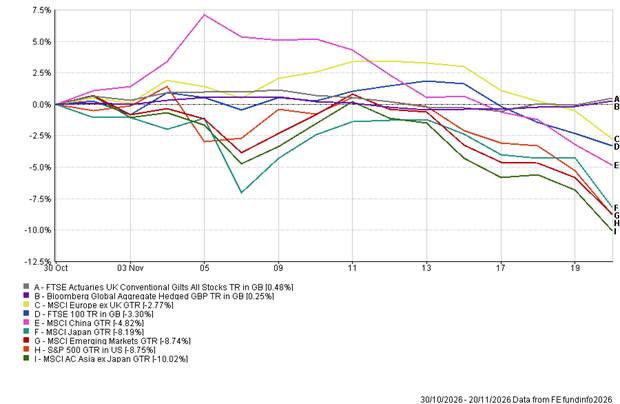
In the five sessions to Friday, the S&P 500 fell 8.6% in US dollar price terms. It closed at 6,910.39, 11.6% below its 6 October closing record. The Nasdaq-100 finished nearly 20% below its October peak. The accompanying chart shows how widely the selling spread.
The sell-off has spread through the global semiconductor supply chain and far beyond individual technology shares. Both the S&P 500 and Nasdaq-100 fell below their 200-day moving averages, although their equal-weight counterparts have so far found support. That difference offers some encouragement, but remains fragile. Government bonds’ relative resilience suggests investors are reassessing risk, not abandoning all financial assets. This is a painful correction, not yet convincing evidence of an impending recession.
Profits and prices have taken different paths
Against this backdrop, the latest American earnings figures deserve serious consideration. With 93% of S&P 500 companies having reported, 84% of those reporting have beaten earnings forecasts. FactSet puts blended third-quarter earnings growth at 32.9% year on year, combining reported results with estimates for companies still to report. The breadth is encouraging: all eleven sectors are reporting year-on-year earnings growth. The surprises have, admittedly, been smaller than the historical average, and unusually large gains in energy and technology flatter the headline growth rate. We should not pretend that every sector is experiencing the same prosperity.

Figure 2. The share of reporting S&P 500 companies beating EPS forecasts, with blended Q3 earnings growth. Source: FactSet Earnings Insight, 20 November 2026.
The contrast with market performance is striking. On FactSet’s figures through Thursday’s close, the S&P 500 price had fallen 6.2% since the end of September while forward 12-month earnings estimates had risen 4.4%. By Friday’s close, the index was down 9.7% over that period. Yardeni Research put its forward multiple at 16.4 times, the lowest since the 2022 bear market on its figures. Yardeni’s calendar-2027 earnings estimate reached about $428 per index share, with rolling 12-month earnings approaching $422. Investors are paying considerably less for each dollar of expected profit, even as those forecasts rise. Of course forecasts may disappoint, but collapsing valuations are not the same as collapsing earnings.
The valuation reset is particularly severe among growth shares. On Yardeni’s figures, the S&P 500 Growth index trades at 17.8 times forward earnings, down from 29.7 late last year. The S&P 500 Value index trades at 17.3 times. That premium has almost disappeared. Meanwhile, earnings growth is broadening beyond the biggest technology companies. FactSet’s blended third-quarter earnings growth for the other S&P 500 companies is running ahead of the 27% reported by the Magnificent Seven, although exceptional accounting items complicate the comparison. The market may be becoming more discriminating; in some places, perhaps excessively so.
The productivity dividend may require more patience
I suspect this is the part of the story that investors will eventually find most interesting. For several years, the immediate winners from AI have been relatively easy to identify: chip designers, memory manufacturers, cloud providers, electrical equipment suppliers and businesses building data centres. Their revenues reflect the immense cost of constructing the infrastructure. The harder question is what happens as the technology becomes embedded in ordinary commercial activity.
Here the evidence is beginning to improve. In McKinsey’s global survey, published in August, 44% of respondents at organisations already using AI said it was being rolled out across the business, up from 38% a year earlier. Four in five of those using AI at work said it had improved their own productivity. Some 37% of survey respondents reported a positive contribution to their organisation’s earnings before interest and tax, broadly unchanged from 2025. The picture is therefore not one of an empty promise, but of benefits arriving at different speeds.
There is a practical difference. Saving an employee an hour is not the same as increasing a company’s profit. Businesses must reorganise workflows, improve products, convert freed capacity into additional sales and learn to control the cost of using the technology itself. Some will do this well, others poorly. The organisations already redesigning their processes rather than simply attaching AI to existing tasks appear better positioned to capture the rewards. In time, those rewards may reach manufacturers, retailers, healthcare providers, professional services and many other industries that are not normally described as AI companies.
Could some of the strength in corporate margins and earnings already reflect this process? Possibly, although it is too early to tell how much. Yet the longer-term prospect is genuinely exciting. If businesses can produce more with the same resources, AI could lift output, improve margins and support faster economic growth across far more industries than technology alone. Those benefits can compound, and may ultimately prove considerably larger than today’s early profit figures suggest. The infrastructure bill is arriving now; the wider productivity dividend will take time. Financial markets, unfortunately, are not always built for patience.
Figure 3. Enterprise rollout, individual productivity and reported company-wide earnings impact, by respondent group. Source: McKinsey, The state of AI in 2026: On the road to ROI, 25 August 2026.
Echoes of 2018, but not a carbon copy
There are uncomfortable echoes of the final quarter of 2018. Then, too, the US economy was expanding and corporate profits appeared relatively healthy. Nevertheless, Fed tightening, higher borrowing costs and the trade dispute with China drove the S&P 500 down 19.8% from its September peak to Christmas Eve. What is easy to forget is the speed of the recovery. From that Christmas Eve low, the index surged almost 25% and surpassed its previous closing record on 23 April 2019 — less than four months later. Investors waiting for an unmistakable improvement in the economy would have missed much of the rebound. A more patient Fed and hopes of progress on trade helped turn the tide. Better-than-expected earnings reports helped carry the index to a new closing high in April.
The analogy is useful because it reminds us that share prices can fall far faster than businesses deteriorate. But it is no promise of a repeat performance. Inflation is a more difficult opponent today, partly because the enormous AI investment programme itself is adding demand for power, equipment and skilled labour. A central bank that fears persistent inflation may have less freedom to reassure markets than investors enjoyed in early 2019.
That is worth remembering when the outlook feels bleak. The VIX closed near 36 on Friday, while the latest AAII survey still showed above-average pessimism among US individual investors. Neither reliably identifies a market bottom. Recoveries can begin abruptly, before the news is unambiguously good and before investors feel comfortable buying. Sometimes the catalyst is simply that feared outcomes become less likely. None of this guarantees another 2019-style rebound, but it is a useful counterweight to the assumption that falling markets must be followed by years of disappointment.
The Fed, UK and the wider world
The Fed’s October minutes, published on Wednesday, showed that almost all participants expected further rate rises if the economy evolved as they anticipated. The Fed held rates at 3.75%–4.00% in October, while its markets desk reported particularly sharp widening in spreads on high-yield bonds financing data centres. A renewed increase in interest rates would be particularly awkward for highly leveraged infrastructure developers whose spending arrives years before their hoped-for profits. Yet a more selective credit market could ultimately improve the quality of the investment being undertaken.
There have been some counterweights. January Brent fell 3.4% over the week to $92.57 a barrel, helped by a recovery in shipments through the Strait of Hormuz. If sustained, lower crude prices could ease some inflation pressure, though regional tensions and refined fuel costs still matter. Government bond prices have held up better than equities in this latest episode, suggesting that not all the news from financial markets is uniformly discouraging.
The UK faces its own uncomfortable balance. Annual CPI inflation rose from 3.5% to 3.6% in October, and the Bank of England raised Bank Rate by a quarter point to 4% earlier this month. UK retail sales volumes rebounded 0.7% in October after a revised 0.6% fall in September. Activity is not uniformly weak, but neither can policymakers ignore the pressures on household budgets and borrowing costs. Euro-area industrial output edged up in September but remained 1.5% below a year earlier. Asia, especially the semiconductor supply chain, has been at the centre of the selling. None of these economies operates in isolation from the global repricing of risk.
Looking ahead…
The question investors are understandably asking is where the next piece of good news will come from. Nvidia has already reported exceptional results. Anthropic has successfully raised capital. Corporate America is producing strong earnings. If those developments have not restored confidence, it is difficult to nominate an obvious event that will.
A softer inflation reading, a less threatening message from the Fed, more stable credit spreads or clearer evidence that AI is improving the profits of its customers could each help. Wednesday’s US personal consumption expenditure inflation figures and second estimate of third-quarter GDP will give us the next read on that balance. It is also possible that markets simply need time to absorb the correction. We cannot know whether the low has been seen, and we should be wary of anyone suggesting otherwise. Volatility may remain uncomfortable, particularly while financing and regulatory uncertainties persist.
But neither should we allow the market’s present anxiety to become our entire assessment of the future. Share prices are the daily verdict of buyers and sellers; earnings and cash flows tell us something more durable about the businesses we own. The evidence still points to considerable corporate resilience. If AI enables businesses to do more with less, the consequences for productivity, profit margins and economic growth could be profound — and not confined to a handful of technology giants. We are still early in discovering how broadly those benefits might spread. The strongest reassurance is not that prices must immediately recover. It is that a difficult month in markets does not invalidate years of economic opportunity.
The great irony of the AI revolution is that a technology promising extraordinary gains in productivity may first add to price pressures as businesses compete for power, equipment and skilled labour. Investors may have to be more patient than they expected. History suggests patience is often rewarded, though never without testing our conviction along the way.