
Market Matters – Earnings Have Some Explaining To Do
The remarkable thing about this bull market is not simply that it keeps rising, but how much bad news it absorbs along the way. The S&P 500 briefly reached another all-time high midweek, stumbled as investors questioned some of the numbers underpinning the artificial intelligence boom, and still delivered a total return of 1.35% in sterling. Chinese equities and the FTSE 100 also advanced, while Japan, continental Europe and Asia outside Japan were less convincing. Smaller US companies, more exposed to borrowing costs, continued to find life difficult.
With the ten-year US Treasury yield above 5%, oil stubbornly expensive and the geopolitical backdrop deteriorating again over the weekend, it is reasonable to wonder what equity investors are celebrating. The answer, I suspect, is less mysterious than the headlines suggest. Corporate earnings remain unusually strong and, as another reporting season gets underway, that may prove more important than the reasons markets are supposed to be worried.
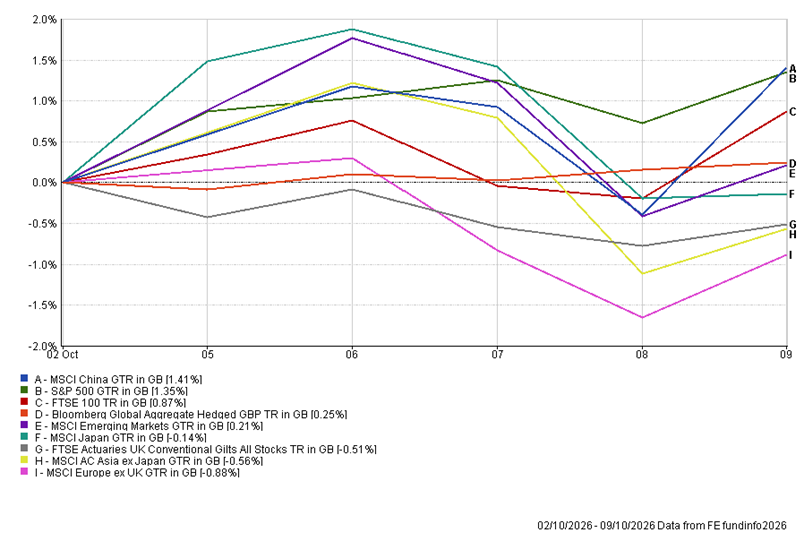
Major asset markets: total returns in GBP, 2–9 October 2026. Equity indices use gross total returns. The Bloomberg Global Aggregate index is hedged to GBP. Source: FE fundinfo.
Profits, Not Just Optimism
The latest FactSet numbers are extraordinary. S&P 500 profits are expected to be 29.6% higher than a year ago in the third quarter, potentially the third consecutive quarter of earnings growth above 25%. That is hardly the normal rhythm of a mature equity market. More unusually, analysts raised their profit estimates during the quarter. In most quarters they quietly reduce them, making life easier for companies when results arrive. This time the bottom-up third-quarter earnings-per-share estimate rose 1.4% between the end of June and the end of September, compared with an average decline of 2.2% over the past five years.
FactSet also points out that companies usually beat final forecasts. If that pattern repeats, overall earnings growth could exceed 35%. There is no guarantee, but the direction is encouraging. Technology and energy account for much of the improvement, yet the positive earnings picture is not confined to one industry. It is increasingly difficult to argue that higher stock markets are supported by little more than enthusiasm.
Perhaps the most interesting consequence is what has happened to valuations. Share prices have risen, but forecast earnings have generally risen faster, leaving forward price/earnings multiples lower than they were earlier in the year. Yardeni’s figures put the MSCI USA Index on 19.4 times the next twelve months’ expected profits at 9 October, compared with 21.5 times at the end of May. The MSCI All Country World Index excluding the US has moved from 14.2 to around 12.5 times over the same period. Our second chart illustrates the compression. American equities are still expensive relative to most of the world and nobody should confuse a lower multiple with an absolute bargain. Nevertheless, it is reassuring that companies are, at least to some extent, growing into their valuations.
This is important for the coming weeks. We remain more concerned about disappointing growth expectations or further valuation compression than an outright collapse in corporate earnings. Markets no longer require ever-higher multiples to keep moving forward. They do, however, need companies to deliver.
MSCI USA and MSCI All Country World ex-US: forward P/E ratios, 2002–9 October 2026. Index prices divided by next-twelve-month consensus earnings, expressed as multiples. Source: Yardeni Research, LSEG Datastream and I/B/E/S.
When Money Becomes Expensive
If earnings explain the strength of equities, bond markets explain much of the nervousness beneath the surface. The sharp rise in government yields over recent months has begun to stabilise, but borrowing costs remain uncomfortable. In the United States, better-than-expected growth, persistent energy inflation and enormous financing requirements have combined to push the ten-year Treasury yield above 5%. France faces a rather different problem: weak fiscal credibility and a political system struggling to agree on how to bring the public finances under control. The still-wide gap between French and German borrowing costs, despite some respite this week, is another reminder that markets have rediscovered an appetite for fiscal discipline.
Could extraordinary demand for capital to finance AI infrastructure be crowding out conventional investment? There is some logic: technology companies are raising enormous sums to build data centres, but capital is not unlimited. The evidence is inconclusive, however. Some economists see higher yields primarily as a consequence of stronger growth rather than AI borrowing. I would be wary of treating crowding out as an established fact.
What is beyond dispute is that a small business, mortgage borrower or indebted government experiences higher rates differently from a cash-rich technology company. The Russell 2000’s weakness is one expression of that divide. There is a constructive side too. Higher starting yields have made government bonds attractive in their own right, offering investors a respectable prospective return without relying on heroic equity performance, although duration and, for overseas holdings, currency exposure still matter. That creates a tougher hurdle for shares, but a healthier range of choices for diversified portfolios.
AI: The Profits Are Real, but So Are the Expectations
Samsung provided an extraordinary illustration of AI’s investment cycle last week. Preliminary third-quarter operating profit was approximately 107 trillion won, nearly nine times the previous year’s level, as memory-chip demand continued to overwhelm supply. Yet its shares slipped. When investors have grown accustomed to exceptional results, even exceptional results can disappoint. It reminds us there is a considerable difference between a wonderful business environment and an attractive share price.
Taiwan Semiconductor supplied another indication of the strength of demand: September revenue rose 54.6% year on year in Taiwan dollars, although it was 0.6% below August. Its forthcoming results will show more about how that sales growth is translating into profits.
At the other end of the supply chain, an apparent discrepancy in OpenAI’s annualised revenue caused a brief wobble in semiconductor and infrastructure stocks. Reports of a roughly $50 billion September revenue run-rate, against an earlier indication near $70 billion, seemed alarming. Reuters subsequently reported that the discrepancy largely reflected an attempt to make the figures comparable with Anthropic’s treatment of cloud-partner revenues, although OpenAI did not publicly confirm that explanation. These are annualised run-rates, rather than revenue earned over a full year. The episode showed how much confidence rests on figures from large private companies that are not reported with the consistency investors expect from listed businesses.
None of this weakens the evidence that AI usage and the demand for computing capacity continue to grow rapidly. The huge investment projects being planned across Europe, including Finland and Italy, reinforce the point that this has become a global physical infrastructure cycle as much as a software story. We remain positive on companies supplying essential memory, semiconductors, power, cooling and electrical equipment, although rising financing commitments deserve attention. Our concern is not that a large debt issue signals trouble. It is whether the ultimate customers generate enough revenue to justify the infrastructure being built on their behalf. The distinction is between financing a genuine expansion and using increasingly elaborate financing to sustain expectations of one.
Energy Is Beginning to Dictate Foreign Policy
The weekend supplied another grim reminder that the Middle East cannot be treated as a contained disturbance in oil markets. Saudi authorities reported that Saturday’s attack on Riyadh’s international airport killed 12 people and injured 309. It was the third attack on the airport during the week, amid renewed fighting with Yemen’s Houthis and efforts by the Saudi-backed coalition to regain territory around the strategically vital Bab el-Mandeb Strait. The Houthis have also warned airlines away from Saudi airspace, while President Trump has said Washington may consider joining Saudi operations. Alongside continuing attacks on shipping linked to the Gulf and the Strait of Hormuz, the threat is increasingly to the wider network of transport and trade routes on which energy supplies depend.
This is why diesel, jet fuel, insurance premiums and freight rates deserve as much attention as daily movements in Brent crude. Markets have adapted to disrupted supplies, but adaptation is not resolution. Extra costs continue to reach household budgets, transport prices and inflation expectations, complicating the task facing central banks.
The IEA’s response underlines the pressure in diesel markets. On Wednesday, member governments backed faster delivery of previously pledged oil-stock releases, prioritising diesel where possible. Around 100 million barrels remained outstanding under the March commitments; this was an acceleration of existing support rather than a fresh pledge.
The political consequences are becoming as important as the economic ones. On Friday, Trump announced an agreement with Vladimir Putin to bring Russian diesel back onto world markets, relaxing restrictions intended to limit Moscow’s war revenues. On Saturday he suggested Ukraine needed a new president who could reach a settlement with Russia, and blamed Volodymyr Zelenskyy for part of America’s diesel problem. Kyiv and European governments reacted angrily. There is a striking contradiction in a White House trying to restrain Russian aggression while providing Moscow with fresh export revenues. It also reveals the pressure from fuel prices ahead of November’s midterms.
Our hope is that diplomacy with Iran still remains possible. Negotiations through regional intermediaries continue and, in our view, the broad shape of a settlement is easier to imagine than a few months ago. Yet sequencing, verification and sanctions relief remain difficult obstacles, while escalation around Yemen hardly helps. We should not mistake a plausible off-ramp for evidence it is about to be taken. For investors, the danger is that a prolonged energy shock keeps inflation and interest rates higher than corporate earnings can comfortably absorb.
Beyond America
It would be easy to conclude that Europe is being left behind, but the picture is more interesting. Germany raised its 2026 growth forecast from 0.5% to 1.3%, helped by exports and investment in defence and infrastructure. That is welcome after years of industrial disappointment. The much-publicised 10.6% monthly plunge in German factory orders in August also looks less dramatic once unusually large orders are excluded: the remaining orders fell just 0.1%. On the same basis, however, orders over the latest three months were 2.6% below the preceding three months. The recovery remains uneven, but there is life in the industrial economy.
There is also a reason to remain open-minded about investing outside the United States. At the end of September, America represented roughly 64% of the MSCI All Country World Index, while the rest of the world generally trades on significantly lower earnings multiples. That discount is not an automatic invitation to buy: Chinese technology, for example, remains vulnerable to weaker domestic demand, regulatory intervention and geopolitical restrictions, however compelling its industrial ambitions may look. Nevertheless, stronger earnings and more modest valuations provide a perfectly respectable foundation for wider global opportunities. The question is not whether to abandon America, but whether the dominance of a relatively small number of American companies should dictate an investor’s entire equity exposure.
Looking Ahead
Next week should help resolve some questions. The US banks begin reporting in earnest, offering an early reading of credit quality, consumer finances and business confidence. Semiconductor updates from ASML on Wednesday 14 October and Taiwan Semiconductor on Thursday 15 October should reveal more about the AI equipment cycle. Wednesday’s US consumer-price report will be important with yields elevated, the Federal Reserve meeting on 27–28 October and energy prices uncertain. France’s budget debate and events around the Gulf will continue to influence bond and currency markets.
My assessment remains constructive, although less carefree than the index levels might imply. Profits are growing, the investment cycle is exceptionally strong and valuations have actually eased in a number of major markets. Against that we have expensive money, an increasingly complicated geopolitical landscape and investors who have become used to very good results. Bull markets do not need the absence of problems to survive, but they do need earnings to keep justifying the faith placed in them. The next few weeks should tell us rather a lot about whether that faith remains well founded.