
Market Matters – A bumpy road to higher ground
Summary:
- Equities remain resilient, supported by earnings. US markets recorded their first positive week in three, with the S&P 500 approaching its record high. Improving earnings expectations provide support, although the divergence between technology and smaller companies highlights an uneven recovery.
- Bond yields are raising the valuation hurdle. Following last week’s return to around 5%, the US 10-year Treasury yield moved decisively above that level, ending Friday at 5.17%. Resilient demand, inflation pressure and heavy borrowing continue to challenge valuations, particularly for companies whose profits lie further into the future.
- Energy remains the principal transmission risk. Friday’s oil-price relief preceded a weekend setback in Iran diplomacy. Disrupted shipping, higher distribution costs and thinner European gas reserves leave scope for the geopolitical shock to sustain inflation and constrain monetary policy.
- Growth is holding up, but offers little prospect of easier financial conditions. September’s business surveys showed expansion across the US, euro area, Japan and UK, with American activity strongest. The combination of resilient demand and renewed cost pressure supports revenues while complicating the outlook for interest rates.
- We remain cautiously constructive. Earnings resilience and AI’s productivity potential support continued equity exposure, but rising infrastructure financing needs increase the importance of demonstrable returns. Selectivity around earnings quality, balance sheets and cash conversion remains central.
Full market insight:
At first glance, Friday looked like a reprieve. Shares recovered as oil eased, and the main US indices finished the week higher. Yet the move in the 10-year Treasury yield was a reminder that markets are still negotiating with a difficult mix of resilient demand, renewed inflation pressure and heavy government borrowing. The central question for investors is not whether there are risks. There plainly are. It is whether those risks are about to overwhelm earnings and the underlying growth story. For now, the evidence still argues for caution without surrendering the longer-term opportunity. Bull markets have a habit of climbing a wall of worry; they do not need every worry removed before they can make progress.
The market held its nerve, but the bond market is asking questions
The S&P 500, Dow and Nasdaq all rose on Friday, helping the US market record its first positive week in three. The Dow gained 478 points on the day, while the S&P 500 finished within 0.7% of its August record. Brent futures fell 2.1% on Friday to settle at $104.32 a barrel as hopes of a diplomatic route through the Iran crisis improved. That combination allowed equities to recover from a week of sharp swings, but it does not amount to an all-clear. The rise in shares depended in part on oil retreating and bond yields coming off their highs. If either reverses, the same market sensitivity will quickly return.
In sterling terms, emerging markets and Japan also made progress, while Europe edged higher and the UK slipped back. Within the US, the recovery remained uneven: the Nasdaq gained 2.1% over the week, but the Russell 2000 fell 0.8%, both in local-currency price terms.
A positive week for most equity regions in sterling
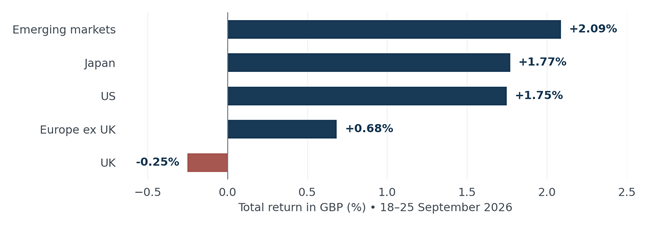
Fidelity Index P Acc GBP funds are regional proxies, not direct index returns. Income is reinvested and fund expenses are reflected; valuation times may differ. Source: Morningstar — EM; Japan; US; Europe ex UK; UK.
The hurdle rate has moved higher
Last week we highlighted the 10-year Treasury yield’s return to around 5% and the resilience of equities in the face of higher borrowing costs. This week, that tension sharpened as the yield pushed decisively above 5%, briefly reaching around 5.22%. The Treasury’s daily benchmark stood at 5.17% on Friday, leaving yields firmly above that threshold at the end of the week and around their highest levels since 2007. The market is asking whether current growth is strong enough to keep inflation sticky, whether central banks will have to stay restrictive, and how much government debt investors are willing to absorb at current prices. Equity investors can look through plenty when earnings are growing; the longer yields remain at these levels, the harder that becomes, particularly for companies whose expected profits sit far in the future.
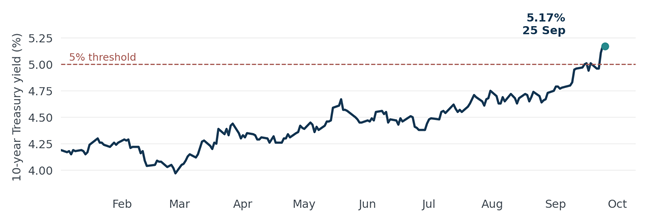
Daily 10-year Treasury par yield, 2 January–25 September 2026. Daily observations are distinct from intraday trading highs. Source: US Treasury.
An off-ramp remains possible, but diplomacy has stalled
Iran indicated during the week it could reopen the Strait of Hormuz within days if the United States eases military pressure and lifts its blockade on Iranian ports. That gives markets a possible sequence to consider: a ceasefire, the restoration of shipping, and wider talks about ending the conflict. It is a meaningful change in the discussion. The debate is no longer only about whether an off-ramp can be imagined; it is increasingly about the conditions and order of steps required to take it.
That opening suffered a setback over the weekend. Trump publicly rejected the proposal on Saturday, while Iran continued to call for negotiations and said it was awaiting a formal response through mediators. An agreement remains possible, but the sequencing is unresolved and Friday’s market relief preceded this latest setback. Markets can trade the prospect of a settlement, but they cannot yet rely on one. The distinction matters: diplomatic proposals remain on the table while the risk of renewed disruption remains high.
The Trump–Xi meeting delivered limited but tangible progress. Alongside the two-month trade-truce extension, the two sides agreed recommendations for more favourable tariff treatment on $30bn of non-sensitive goods in each direction and established an AI-risk dialogue. That buys time and reduces some uncertainty, but falls well short of resolving the larger competition over technology and supply chains. China matters to this story in a second way. Beijing has leverage with Tehran and a direct interest in energy flows, so its role could extend beyond easing tensions to helping make any arrangement stick. That remains a possibility to watch, not a result of the summit.
Oil is still moving, but at greater cost
Saudi Arabia has restored operations on its East–West pipeline after a drone attack, reopening an important route to the Red Sea port of Yanbu. The pipeline is a practical way to bypass Hormuz, but it is not yet running at full capacity and repairs will take time. Gulf producers have also used more expensive ship-to-ship transfers and alternative loading routes to keep barrels moving. These workarounds explain why reported exports can recover even while the underlying system remains fragile. They are evidence of adaptation, not normalisation.
The risk has widened beyond the Strait itself. The Houthi front has reopened, threatening Saudi infrastructure and the Red Sea approach as well as the Gulf. If both routes are exposed, the cost and reliability of shipping matter as much as the headline oil price. Higher freight, insurance and handling costs can feed into diesel and other refined products even when crude falls. Friday’s retreat in oil was welcome, but prices remain elevated and the inflation shock is far from over.
Europe has a separate winter vulnerability. Gas storage is around 70% full, roughly 12 percentage points below a year ago, and Brussels has asked governments to consider measures to restrain demand. There is no physical shortage yet, but the thinner buffer leaves households and industry more exposed if supply disruption persists.
Growth is resilient, though the price of that resilience is rising
The September business surveys give a good sense of the uneven global picture. US activity accelerated sharply, the euro area improved, Japan continued to expand and the UK grew only modestly. All four remained above the 50 level that separates expansion from contraction, but the pace and the inflation consequences differed. The chart below shows the gap between the US and the other developed economies. These readings are surveys rather than final GDP figures, but they are useful early evidence of where activity and costs are moving.
In the United States, the composite PMI rose to 58.4, its strongest reading in more than five years. New orders and employment were robust, pointing to a powerful economy rather than one on the brink of recession. That is good news for corporate sales and profits. It is less comfortable for bond markets when strong demand runs into capacity constraints and firms report rising input costs. The same strength that supports earnings also keeps the pressure on the Fed. Having raised rates to 3.75–4.00% on 16 September, it now has to judge whether further tightening is needed.
Europe’s improvement was broader than many investors expected. The euro area composite PMI rose to 53.1, its best reading since early 2023, with German activity at 53.8 and France returning to expansion. This is encouraging, especially after a long period in which Europe looked structurally weaker than the US. There is a qualification: energy costs pushed prices higher, and the survey pointed to a more hawkish interest-rate backdrop. Better growth is a positive for earnings, but it does not guarantee easier monetary policy when the recovery arrives alongside renewed price pressure.
Japan’s composite PMI eased to 52.5 from 53.5, but still pointed to a solid third quarter. Manufacturing and exports have benefited from a weak yen, while supply delays and imported energy costs remain a problem. The currency is therefore doing two things at once: helping exporters and making imported inflation harder to contain. That complicates the Bank of Japan’s choices and matters internationally because a sharp change in Japanese yields or the yen can unsettle carry trades and add to the global bond volatility already visible in US markets.
The UK picture is more subdued. Its composite PMI slipped to 51.7, indicating a third month of expansion but only modest growth, while input costs and selling prices picked up. GfK confidence edged up one point to minus 13, its best level in two years, but the detail was less reassuring: households were more inclined to save and less inclined to make major purchases. People are still bracing for another rise in household energy costs. It is possible for survey sentiment to improve at the margin while consumers remain cautious about committing money.
The public finances offer little extra room for manoeuvre. August borrowing reached £18.3bn, leaving the financial-year total £8.1bn above the OBR forecast, despite being slightly lower than a year earlier. That raises the stakes for the autumn Budget and leaves less scope to cushion another squeeze on household spending.
China will be a separate test. The latest official manufacturing PMI, for August, was 49.8: a recovery from July, but still just below the expansion line. That sits alongside strength in export-facing manufacturing and continued weakness in domestic demand. The Trump–Xi meeting has bought time for trade talks without removing the risk of renewed friction. The next Chinese PMI release should help establish whether factory conditions are improving into the final quarter, or whether external strength is still masking softer demand at home.
US growth leads the developed economies
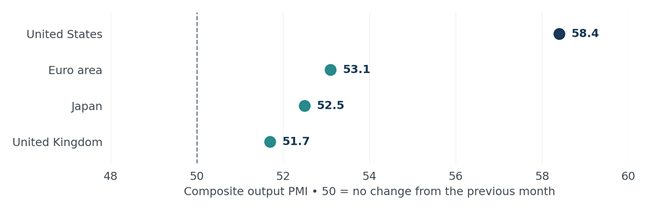
September 2026 flash composite output PMIs. Above 50 indicates expansion from the previous month; these are surveys, not GDP growth rates. Source: S&P Global.
AI remains a large opportunity and a near term financing test
There is a risk that every AI discussion gets reduced to the bubble question. I think the more useful point is that demand for computing is real and AI is already being used in business. The opportunity reaches well beyond software budgets: if AI takes a meaningful share of the knowledge economy—research, coding, customer service, analysis and routine decisions—the addressable market is very large. Lower task costs could accelerate adoption.
The investment question is the pace and quality of revenues. A chip order, data-centre lease or cloud commitment proves demand for infrastructure, but it does not show yet that end customers will pay enough to generate attractive margins and cash flow. The web of commitments among labs, cloud providers, chip companies and infrastructure owners can keep spending moving while making the economics hard to see. In parts of the AI infrastructure build-out, financing commitments are running well ahead of the cash flows those projects must eventually generate.
Nscale illustrated the point this week, announcing $3.36bn of convertible financing, comprising an initial $2.36bn tranche and a further $1bn commitment from Nvidia expected in November. Capital is available, but supplier involvement in customer funding makes the eventual cash returns worth watching closely.
The bond market is asking similar questions. Goldman Sachs expects hyperscaler gross debt issuance to reach $420bn next year, 60% above its 2026 estimate. Investors are demanding more compensation for the volume of supply and uncertainty over returns, even where balance sheets remain strong. Capital Group’s analysis shows that spreads on longer-dated US-dollar hyperscaler bonds widened through August, while the broader investment-grade market ended the month little changed from the start of the year.
Longer-dated hyperscaler debt has repriced
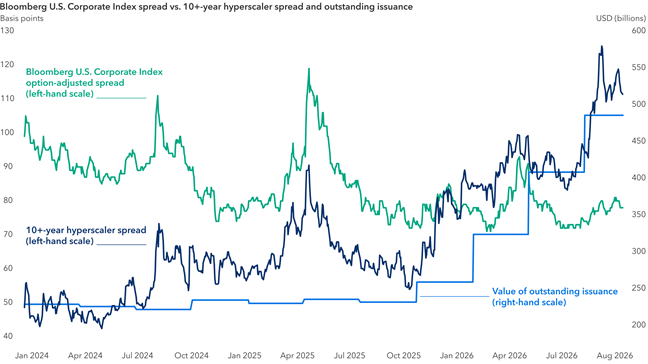
US-dollar credit, data to 31 August 2026. Hyperscaler bonds with maturities of 10 years or more are compared with the broad Bloomberg US Corporate Index. Outstanding issuance uses the right-hand scale. Maturity and issuer mixes differ, so the spread gap is not a like-for-like AI risk premium. Source: Capital Group, 23 September 2026; underlying data from Sage and Bloomberg Finance L.P.
That is a reason to be selective, not to dismiss the opportunity. Better placed businesses can show sustained utilisation, recurring demand and cash conversion, or provide essential equipment across a range of possible winners. The weaker proposition is to assume that every project will be refinanced and every workload will be profitable. Over time AI could lift productivity and margins across the economy. Over the next few quarters, investors will want proof that customers are getting measurable value and are willing to pay for it.
There is some substance behind the earnings support. FactSet’s early-September analysis showed third-quarter estimates rising through July and August, when they would normally be drifting lower. The improvement was uneven, but it helps explain why higher yields have not automatically translated into weaker equities.
Earnings revisions provide a measure of support
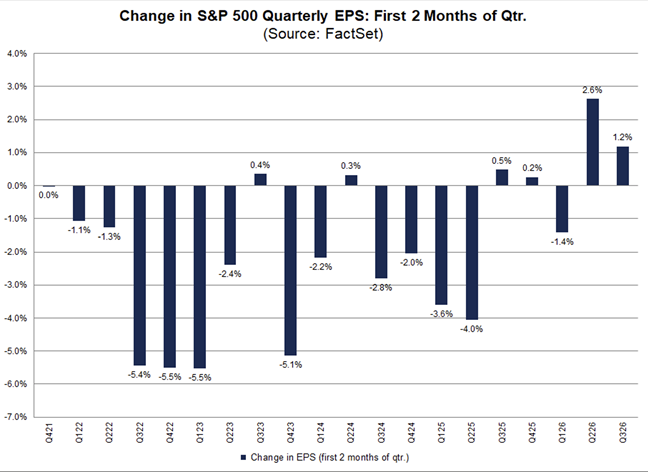
FactSet’s original chart, published 4 September 2026. Q3 estimates rose 1.2% from 30 June to 31 August. Each bar measures estimate revisions during a quarter’s first two months, not realised earnings growth. Source: FactSet.
This week
This week brings another test of whether growth can remain strong without adding to inflation. Wednesday’s US PCE figures and revised second-quarter GDP will be followed by Friday’s employment report, alongside the next Chinese PMIs and US manufacturing surveys. Micron’s results on Wednesday will offer a more specific check on AI memory demand, pricing and capital spending. Oil flows, European gas supplies and long-dated yields remain the market signals to watch.
Our position remains cautiously constructive. Shares are close to their highs, earnings have so far been resilient, and the global surveys offer little sign of an imminent recession. That gives us good reason to remain invested, with a close eye on earnings quality, balance sheets and cash generation. Oil and bond yields remain the main threats, with the potential to turn geopolitical disruption into a more persistent inflation and valuation problem. I would not make a large strategic shift on the assumption that diplomacy will fail, but neither would I mistake another proposal for a lasting settlement.
Bull markets can climb a wall of worry, but valuation still matters. Earnings and the longer-term productivity opportunity provide support, while the bond market suggests the journey may be rougher than share prices imply. If oil flows normalise and companies continue to turn growth into profits, there is room for equities to reach new highs. If yields keep rising and energy costs spread, progress will be harder. For now, higher ground remains a reasonable prospect, even if the road there is bumpy.