
Market Matters – Topsy-Turvy Markets Despite Earnings Beats & Bond Markets Test Warsh
Summary:
- Modest weekly gains of approximately 1.0% for the S&P 500 and 1.6% for the Nasdaq concealed exceptional company-level dispersion, as investors rewarded demonstrable AI revenue growth but increasingly penalised weak cash conversion and excessive capital intensity.
- July’s returns showed pronounced geographic and sector divergence: China and the FTSE 100 advanced strongly, while global technology and Asian markets weakened. China’s equity performance nevertheless contrasted with a manufacturing PMI of 49.2, indicating that the rally was not underpinned by a broad domestic reacceleration.
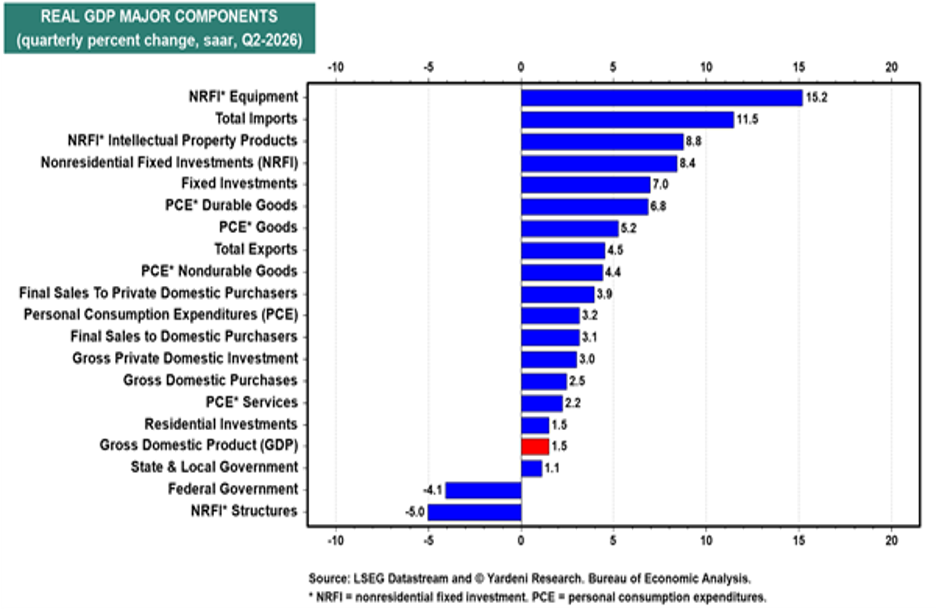
- The US economy remains resilient beneath a subdued 1.5% annualised GDP headline, with private domestic demand expanding by 3.9%. Persistent core inflation, continued household spending and a low saving rate leave limited scope for near-term monetary easing.
- The Federal Reserve’s decision to hold rates at 3.5%–3.75% was accompanied by three hawkish dissents and a steeper yield curve. With the 10-year Treasury at 4.75% and the 30-year at 5.27%, rising discount rates represent an increasingly important constraint on highly valued growth assets.
- Reported currency intervention in the yen, a more hawkish Bank of Japan outlook and continuing disruption to Middle Eastern energy flows add further policy and inflation uncertainty. AMD’s results and the forthcoming US employment report will provide the next tests of AI breadth and monetary-policy expectations.
Where do we start!?
By Friday evening, the headline US indices looked almost calm: the S&P 500 and Nasdaq still gained approximately 1.0% and 1.6% over the week, but those modest headline returns concealed extraordinary dispersion beneath the surface. Thursday brought an extraordinary recovery led by Microsoft, followed by another technology-driven rally after Amazon’s results on Friday. At the same time, Meta and Apple were being punished heavily, for rather different reasons. The dispersion between four of the world’s largest companies was astonishing and made the idea of the Magnificent Seven as one homogeneous investment increasingly difficult to sustain.
I will spare you a detailed tour of every earnings statement because the broader message was relatively simple. Microsoft and Amazon were rewarded because investors could see a clearer connection between the vast sums being spent on AI infrastructure and rapidly growing cloud revenues. Elsewhere, investors were less convinced that the returns were arriving quickly enough to justify the scale of investment. The AI story has not gone away, but the market now wants evidence rather than promises.
The contrast is clearest in the numbers. Azure grew 43% and Amazon Web Services 37%, while Meta’s quarterly free cash flow fell to just $784 million from $8.5 billion a year earlier. Markets are no longer asking whether AI demand exists; they are asking which companies can turn it into durable cash flow after the capital bill.
That also helps explain the volatility in semiconductor shares, which moved violently from day to day and sometimes hour to hour but in the end fell sharply over the week. The results from Microsoft and Amazon suggest that demand for computing power remains extremely strong, but that does not mean every chipmaker, memory producer or data-centre supplier can rise indefinitely. Valuations and expectations had moved a long way, positioning had become crowded and investors had started treating the entire AI supply chain as a single trade. July was a reminder that even a powerful long-term theme can suffer a sharp correction when too much good news is already reflected in prices.
The same pattern appeared in Korean memory: strong AI demand and pricing were not enough to lift shares where delivery against increasingly demanding HBM4 expectations disappointed.
A strange July…
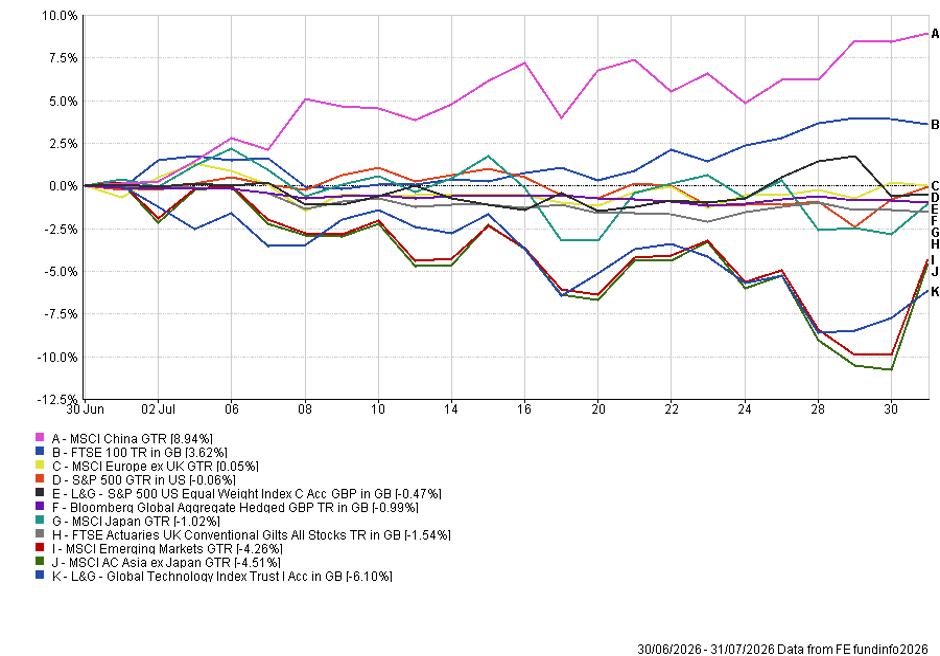
The monthly chart captures just how unusual July was. The S&P 500 ended almost exactly where it started, while the L&G Global Technology Index Trust fell just over 6%. The L&G S&P 500 Equal Weight Index Fund also slipped slightly, so this was not simply a straightforward rotation out of technology and into the average American company.
The regional differences were even more striking. China gained almost 9% and the FTSE 100 rose 3.6%, while broader emerging markets and Asia excluding Japan fell by more than 4%. At one stage late in the month, those Asian indices were down around 10% before staging a remarkable recovery. Bonds were weak too, with global bonds, Japanese equities and UK gilts all losing ground.
China’s strong market return did not reflect a clean domestic reacceleration. Official manufacturing PMI fell to 49.2 in July, with new orders at their weakest level since 2023. The rally therefore appeared to owe more to selective technology and export strength, policy expectations and positioning than to a broad improvement in domestic demand.
Money moved violently between countries, sectors and individual companies. There were days when almost everything associated with AI was sold, followed by days when investors rushed back into precisely the same shares. China and the UK quietly produced strong returns while much of the attention remained fixed on the drama in American technology.
I do not think this tells us that the AI investment cycle has ended, or that investors have abandoned technology. It suggests that we have moved into a more discriminating phase. The market is becoming less willing to pay any price for future growth, particularly while the cost of money is rising and the bond market is becoming increasingly uncomfortable.
Growth is not the problem
Last week’s economic data did little to support the idea that the US is heading towards recession. The advance estimate showed annualised growth of 1.5% during the second quarter. A cleaner measure of private domestic demand (real final sales to private domestic purchasers) rose at a 3.9% annualised rate, suggesting that households and businesses remained healthy beneath the volatile headline components. Higher imports and falling government spending depressed the headline number.
The inflation figures were more awkward. Headline PCE prices fell slightly in June as energy costs eased, but remained 3.7% higher than a year earlier, while core inflation was still 3.3%. At the same time, real consumer spending rose 0.4% and the household saving rate fell to only 2.7%. Consumers were not retreating in response to higher prices; they were continuing to spend and saving less of their income.
That left the Federal Reserve with an uncomfortable choice. It kept rates at 3.5%–3.75%, although three members voted for an immediate quarter-point increase. Kevin Warsh was confident in his delivery and repeated that the Fed would deliver price stability, but confidence is not quite the same thing as convincing markets that you have the problem under control. He offered relatively little guidance on what would cause the Fed to act or how long it was prepared to tolerate inflation remaining so far above target.
In the immediate post-meeting move, the two-year yield slipped while longer maturities rose. By 31 July, the 10-year yield had closed at 4.75% and the 30-year at 5.27%, its highest level since 2007. One plausible reading is that investors wanted more compensation for inflation and policy uncertainty after Warsh offered little guidance. It is not the only explanation: term premia, fiscal supply and expectations of stronger nominal growth can also lift long yields.
That interpretation is not unreasonable. Inflation is still above target, domestic demand remains strong and the economy is being supported by an extraordinary investment boom. AI infrastructure requires enormous quantities of electricity, construction, equipment, memory, cooling systems and skilled labour. Add tariffs, disrupted supply chains and an oil price that rose sharply in July, and it becomes increasingly difficult to assume that inflation will simply drift back to 2%.
Equities have so far absorbed higher yields remarkably well because earnings remain strong and investors do not see an imminent recession. However, if long-term yields continue climbing, the hurdle facing highly valued companies will become progressively higher. Strong growth can support profits, but it does not guarantee rising share prices if the cost of capital is increasing at the same time.
A similar problem closer to home
The Bank of England faced a recognisably similar dilemma, although the UK economy is considerably less dynamic. The Monetary Policy Committee voted by six to three to keep Bank Rate at 3.75%, with a third member joining those calling for an immediate increase. The Bank expects inflation to rise further before gradually returning towards target. Its central forecast assumes that the energy shock fades and produces only limited second-round effects, while the MPC acknowledged that risks remain skewed to the upside.
There was at least some encouragement in the latest business surveys. The UK composite PMI moved back above 50 in July, indicating that activity expanded for the first time in three months. Price pressures eased earlier in the month, although employment continued to fall and some of the improvement reflected temporary factors. The economy appears capable of avoiding a downturn, but it is hardly booming, leaving the Bank trying to balance weak underlying growth against another externally generated inflation shock.
Europe also produced better news than many expected. The eurozone economy grew during the second quarter, while July’s composite PMI reached its strongest level for several months. New orders improved, manufacturing output strengthened and Germany returned to growth. Europe is not suddenly racing ahead, but it does appear to be doing rather better than the consistently gloomy narrative would suggest.
That may help explain why parts of the European and UK equity markets have held up relatively well. Valuations remain lower, expectations are less demanding and even modest improvements in economic activity can make a meaningful difference.
Washington reportedly joins the yen defence
If equity markets were volatile, currency markets were hardly calmer. The yen moved sharply after Japan intervened and, according to reports, the United States joined the operation. Formal disclosure of the joint action was still awaited at the time of writing. The investment relevance is that a stronger yen helps reduce Japan’s imported inflation and benefits unhedged overseas investors, although it can be a headwind for Japanese exporters. More broadly, a rapid yen recovery can force the unwinding of carry trades funded in the cheap Japanese currency, adding another source of volatility across global equities and credit.
Intervention was not the currency’s only source of support. The Bank of Japan held its policy rate at 1%, but warned that underlying inflation could overshoot 2% and said it would continue raising rates if its outlook is realised. Intervention is more likely to prove durable when monetary policy points in the same direction.
It also fits the broader theme of the week. Markets are increasingly testing whether policymakers are willing and able to respond to the inflationary consequences of war, energy disruption and unusually large differences in interest rates.
From bombing to bargaining?
Finally, there is Iran. Only days ago, another round of American attacks appeared imminent. Trump has now said that he will hold off, provided negotiations move quickly towards reopening the Strait of Hormuz and addressing Iran’s nuclear programme. Saudi Arabia and other regional powers have been pushing strongly for diplomacy, understandably concerned that another escalation could bring attacks on their own energy infrastructure.
This is not yet a peace agreement. Previous ceasefires have broken down rapidly, Iran remains publicly defiant and both sides are preserving the option of further military action. Nevertheless, Trump increasingly appears to want to convert military pressure into a deal. Having demonstrated that he is willing to bomb, he now seems keener to claim that the bombing has created the conditions for negotiation.
Brent crude ended July above $90 a barrel after a sharp monthly rise, as traffic through Hormuz continues to be disrupted and the Houthis threatened shipping around Bab el-Mandeb. If a credible agreement restores normal flows, one of the most important sources of near-term inflationary pressure could begin to unwind. If talks fail, oil prices, bond yields and central-bank expectations could all move sharply higher again.
This week and beyond…
After a week like that, making any confident short-term predictions feels particularly unwise. The next major test will be the US employment report. A stronger number would reinforce the argument that the Fed is behind the curve, while a weak one would leave policymakers facing the unpleasant combination of persistent inflation and a cooling labour market.
Before Friday’s employment report, AMD reports on Tuesday, offering another test of whether AI demand remains broad enough (and sufficiently profitable) to support the semiconductor supply chain.
More broadly, we remain reasonably constructive. The global economy is showing considerably more resilience than many expected, corporate earnings continue to rise and the European data are beginning to improve. The AI investment boom also remains very real, even if investors are becoming more selective about who ultimately benefits.
What has changed is the margin for error. Markets are no longer prepared to treat all technology companies alike, and the bond market is no longer prepared to take central bankers’ assurances entirely on trust. War has pushed energy prices higher, inflation remains uncomfortable and governments are intervening more directly in currencies, trade and markets.
That combination is likely to produce more weeks like the one we have just experienced: the headline indices may not move very far, but beneath the surface the winners and losers could be separated by an enormous distance.
Written by Tom McGrath 02.08.2026
Edited by Ash Weston 02.08.2026