
Market Matters – Growth is strong, but becoming expensive
Summary:
- Growth remains resilient, but sustaining it is becoming more expensive. Corporate revenues and economic activity remain strong, while higher oil prices, bond yields and infrastructure costs are putting pressure on valuations and financing assumptions, particularly in US technology.
- Alphabet highlighted both the scale and the cost of AI demand. Its reported earnings were boosted by a $98 billion unrealised investment gain, while adjusted earnings were broadly in line with expectations. Google Cloud growth remained very strong, but negative free cash flow and planned capital expenditure of $195–205 billion increased scrutiny of future returns.
- The semiconductor cycle remains strong, but investor positioning is crowded. Forward revenues, earnings and margins remain exceptionally high, although demanding expectations and concentrated exposure contributed to a correction of more than 18% during July.
- Energy risk has increased across two important shipping routes. Restricted traffic through the Strait of Hormuz, alongside attacks on Saudi tankers and Red Sea oil infrastructure, has reduced the margin for further disruption. Europe may be especially exposed through higher natural-gas prices and relatively low storage levels.
- The investment outlook remains constructive, but greater selectivity is required. Improving UK and eurozone data support the growth outlook, while higher yields reflect resilient activity, energy pressures and rising AI-related borrowing. Current market weakness still looks more like rotation and discrimination within equities than a broad retreat from risk.
Full Insight
Investors faced an unusual combination this week. Economic data improved, corporate earnings remained extremely strong and demand for artificial intelligence continued to accelerate. Yet markets became increasingly uncomfortable. Oil returned above $100 a barrel, government bond yields rose sharply, and Alphabet’s results raised fresh questions about the enormous cost of building the infrastructure required to support the AI boom.
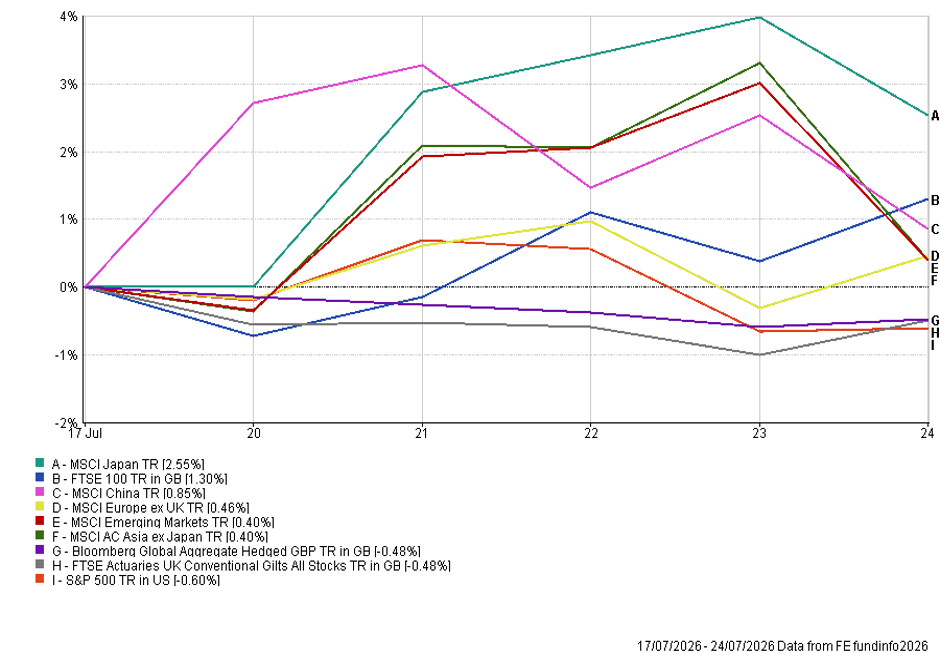
Total returns, 17–24 July 2026. Returns are shown using the currency conventions of the underlying FE fundinfo series; the S&P 500 is shown in US dollars, while the UK equity and bond series are in sterling or sterling-hedged terms. Source: FE fundinfo.
In this context, “expensive” refers not simply to equity valuations, but to the rapidly rising capital, energy and financing required to sustain the current pace of growth.
The weakness was far from universal. The FTSE 100, Japan, China and emerging markets all advanced, while the S&P 500 and government bonds declined. This was less a wholesale retreat from risk than a reassessment of the dominant US technology trade—and of the inflationary and financial cost of sustaining global growth.
Alphabet delivered tremendous growth…but at an enormous cost
Alphabet’s second-quarter results looked almost impossibly strong, with GAAP earnings per share of $9.11, compared with a consensus estimate of $2.88. However, the figure included a $98 billion unrealised gain on equity investments, widely attributed principally to SpaceX. On an adjusted basis, earnings were approximately $2.85 per share against expectations of $2.89. This materially distorted the earnings growth reported for the wider S&P 500.
FactSet’s blended estimate of 37.9% falls to 25.9% when Alphabet is excluded. Separately, Yardeni Research estimates that removing Alphabet’s mark-to-market investment gain reduces underlying index growth to approximately 22%. With only around 27% of companies having reported, these figures will continue to evolve. Still, the broad conclusion is unchanged: headline earnings are flattered by accounting gains, while the underlying earnings season remains exceptionally strong.
The broader evidence supports that view. Of the S&P 500 companies to have reported so far, 86% have beaten earnings expectations, ten of the eleven sectors are producing profit growth, and all eleven are generating higher revenues. Analysts’ estimates for 2027 also continue to rise. There is therefore still little in the corporate data to suggest that a recession is imminent.
The more important Alphabet story was beneath the headline earnings. Google Cloud revenues grew by 82%, confirming that demand for AI computing capacity remains extremely strong, but meeting that demand is becoming extraordinarily expensive. Alphabet generated negative free cash flow of $5.9 billion during the quarter and raised its 2026 capital-expenditure guidance by another $15 billion, to a range of $195–205 billion. Investors are no longer questioning whether AI demand is real; they are asking how much the hyperscalers must spend before it produces an acceptable return. That same test now moves to Microsoft, Meta and Amazon, where free cash flow and investment guidance may matter as much as revenue growth.
Semiconductors remain at the heart of the AI build-out
Within the S&P 500 Semiconductors industry group, forward revenues have more than doubled over the past year, while forward earnings have risen by more than 160% and expected profit margins have reached record levels. Some of this reflects higher prices and shortages in areas where capacity has struggled to keep pace with demand, but the story is broader than that. AI investment is spreading beyond the leading processors into memory, lithography, advanced packaging and the wider data-centre supply chain, creating a much deeper and more diverse growth cycle than the market initially expected.
There will inevitably be periods of volatility after such strong gains, particularly as semiconductor shares have become heavily represented in momentum strategies and crowded portfolios. Expectations are also demanding, so not every company will meet them. The Philadelphia Semiconductor Index fell by more than 18% during July, but remained nearly 65% higher year to date. In our view, the recent weakness therefore looks more like a positioning reset and profit-taking than evidence that the underlying cycle has broken. Building advanced semiconductor capacity takes years; the technical barriers remain formidable, and demand continues to broaden. The industry will never lose its cyclical characteristics, but the scale and duration of the AI infrastructure build-out suggest that this cycle may have considerably further to run.
The Gate of Tears became a second concern for energy markets

Oil moved back above $100 a barrel after the Houthis attacked Saudi tankers in the Red Sea. The risk escalated further on Saturday, when the group fired on Saudi oil installations at Jizan and Yanbu on the Red Sea coast. This does not yet amount to a sustained disruption of exports, but it moves the issue beyond threats to shipping and into direct attacks on infrastructure being used to bypass the Strait of Hormuz. For several months, Saudi Arabia has been using its western pipelines and Red Sea terminals to reduce its reliance on Hormuz, which made the attacks particularly significant. Hormuz guards the exit from the Persian Gulf; Bab el-Mandeb (the Gate of Tears) guards the southern entrance to the Red Sea. Disruption at both would make it much harder and more expensive to move Middle Eastern oil to global markets.
Source: U.S. Energy Information Administration, World Oil Transit Chokepoints, Figure 6.
It is important not to exaggerate the immediate threat. The Red Sea is not yet another Hormuz. Other vessels continued to use the route, and the Houthis do not possess Iran’s ability to sustain a large-scale blockade. Nevertheless, even intermittent attacks can increase insurance costs, delay journeys and force tankers onto much longer routes around Africa. Brent settled back below $97 on Friday after closing above $100 the previous day, but the geopolitical risk premium remains considerable.
The interesting part of the oil story is how well the global economy has coped with the severe restriction of traffic through Hormuz so far. Releases from strategic reserves, alternative supplies and weaker demand have all helped. China has been particularly important, drawing on inventories while its oil imports have fallen substantially. The rapid adoption of electric vehicles and renewable power may also be contributing to structurally slower growth in Chinese oil demand, although it is too early to distinguish that effect fully from inventory drawdowns and disrupted imports.
The market is not yet facing an uncontrollable global shortage, and much of the latest move reflects traders buying protection against one. But the margin of safety has narrowed. If disruption spreads from Hormuz into the Red Sea for any length of time, the risk premium could quickly turn into a genuine physical supply problem. European natural gas prices may be an even greater concern than oil. The regional benchmark has moved above €60 per megawatt-hour, while storage is below 54%, materially lower than both last year and the seasonal norm. That is an uncomfortable combination as the summer refill season advances and could have a more direct impact on European industry and household bills.
Good news from the UK and Europe
Against this difficult backdrop, the economic data were surprisingly encouraging. UK retail sales volumes rose by 1% in June, following a 1.2% increase in May. Warm weather and promotions helped clothing and online retailers, so some of the improvement may prove temporary, but household spending appears to have entered the summer with more momentum than expected.
Business surveys told a similar story. The UK composite PMI rose from 49.3 to 52.1 in July, its highest since April and consistent with modest economic growth. Manufacturing recorded its strongest increase in output for nearly two years, helped by exports and AI-related investment, while services returned to growth. Employment continued to decline, although at a slower pace.
The eurozone composite PMI also surprised positively, increasing from 50.0 to 51.9. Germany returned to growth, France’s contraction eased and manufacturing conditions improved. The reading was consistent with quarterly economic growth of around 0.3%, which would represent a welcome improvement following a largely stagnant second quarter. There is one caveat: the surveys captured the benefit of lower energy prices during the first half of July and largely predated the latest move in oil and gas. The UK and Europe entered the third quarter with more momentum than expected, but we will now have to see whether that improvement can survive another energy shock.
A difficult first week for Burnham, but this was a global bond sell-off
Andy Burnham’s first week in Downing Street was never likely to be quiet. His suggestion that the government might use “any flexibility” available within the fiscal rules was interpreted by investors as a hint of more borrowing, and UK gilt yields initially rose faster than those in other markets. The subsequent emphasis on fiscal discipline, together with John Healey’s appointment, tempered the initial reaction, although it did not reverse it: gilt yields still reached fresh two-month highs the following day. Lower-than-expected UK inflation of 2.6% was also helpful, but it would be wrong to blame the movement in gilts primarily on British politics.
Government bonds sold off across the world. Oil was higher, economic data were resilient and markets became increasingly concerned that central banks may have to raise rates again. The US ten-year Treasury yield approached 4.7%, while the 30-year yield moved close to its highest level since 2007. By the end of the week, markets were pricing approximately a 38% probability of a quarter-point Federal Reserve rate rise at the coming meeting, up from around 13% a week earlier.
The extraordinary investment programme being undertaken by the hyperscalers may also be becoming a bond-market issue. AI infrastructure is increasingly being financed through corporate borrowing as well as existing cash flow, adding another significant source of bond supply at a time when governments are already borrowing heavily. This is no longer a marginal credit-market issue. Global AI-related debt issuance is forecast to approach $570 billion in 2026, giving the investment cycle sufficient scale to influence corporate spreads, market capacity and, at the margin, longer-dated yields. Burnham may have given gilt investors another reason to be nervous, but he did not create the global rise in yields.
This week…
The coming week is unusually important. The Federal Reserve meets on Wednesday. An unchanged rate remains the base case, but a meaningful minority of investors now sees a surprise increase as plausible. Microsoft, Meta, Amazon and Apple will report into a market newly focused on the cost of AI rather than simply the scale of its opportunity, while 177 S&P 500 companies are due to announce results.
Our central view remains constructive. Economic growth is proving resilient, corporate revenues are expanding and underlying earnings growth remains comfortably above 20%. Those are not the usual ingredients of a serious bear market. For diversified portfolios, the important distinction is between weakness in the most capital-intensive parts of the US technology market and a broader deterioration in corporate fundamentals.
The evidence still points more clearly to rotation and greater discrimination within equities than to a wholesale retreat from risk. The risks, though, have become clearer. If oil remains above $100, bond yields continue to rise and the hyperscalers cannot demonstrate an improving return on their vast investment, markets may have further adjustment ahead. If energy prices retreat and next week’s technology results show that strong AI revenues are beginning to catch up with expenditure, this week’s setback may prove to have been another rotation rather than the end of the equity advance.
Written by Tom McGrath 26.07.2026
Edited by Ash Weston 26.07.2026